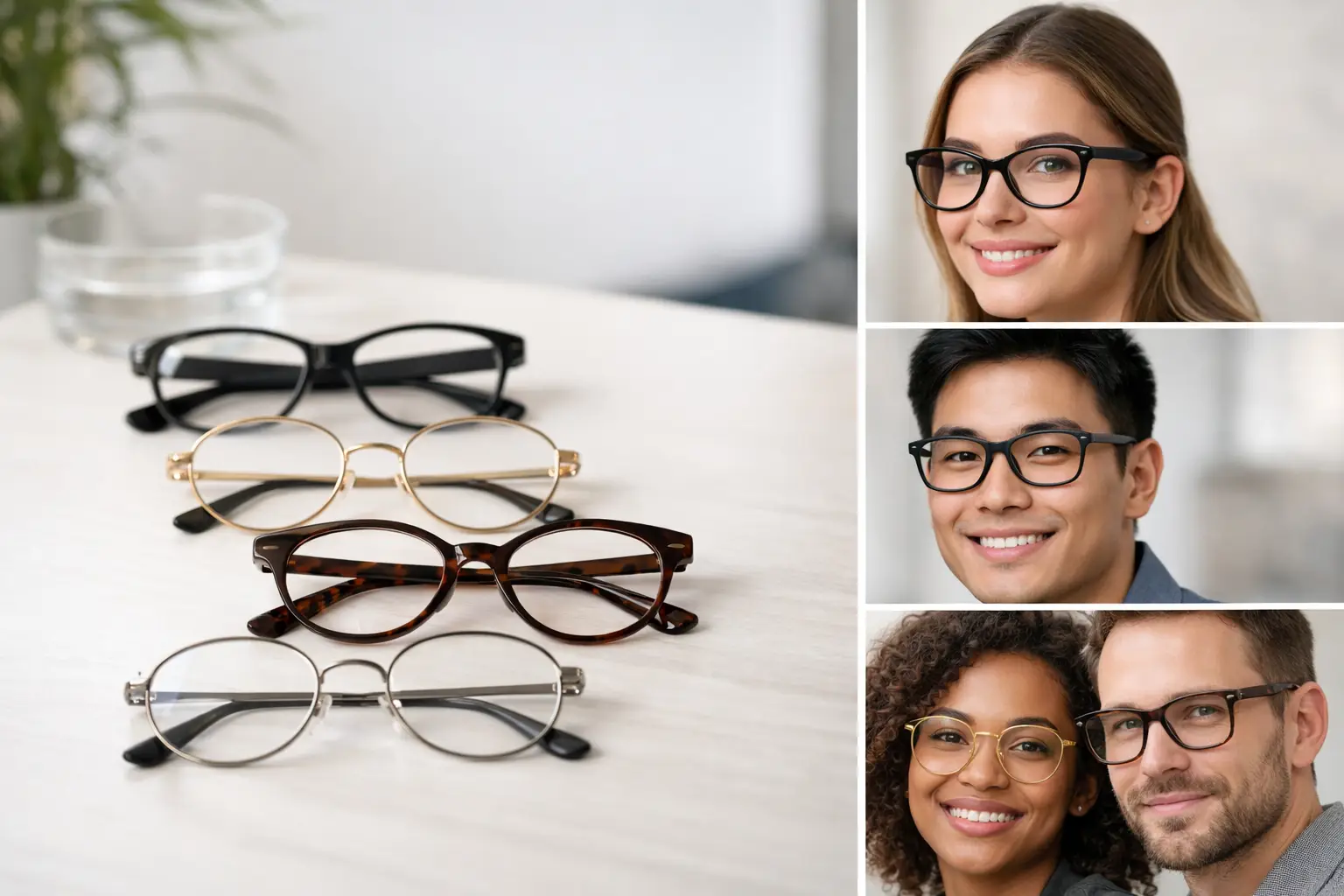
A frame can make your glasses feel like part of you – or like something you cannot wait to take off. The best glasses frame shapes are not simply those that match a face-shape chart. They are the ones that sit comfortably, give you clear vision, suit your prescription and reflect how you want to feel when you wear them.
At an eye examination, we focus on the health and clarity of your vision first. When it is time to choose glasses, the fitting matters just as much. A considered choice can make reading, driving, screen work and everyday wear more comfortable, while helping you feel confident in your look.
Start with your features, not a strict face-shape rule
Face-shape advice is a useful starting point, but it should never feel like a rulebook. Most faces are a blend of oval, round, square, heart or diamond characteristics. Your brow line, cheekbones, nose bridge, colouring and personal style all influence which frame will look and feel right.
The most flattering frames often create gentle balance. A rounder frame can soften strong angles, while a more structured frame can add definition to softer features. However, the right pair is the one that makes you feel comfortable and recognisable when you look in the mirror, not one that follows a label exactly.
Frame width is especially important. In most cases, the front of the frame should broadly follow the width of your face without extending far beyond it. The eyes should sit close to the centre of each lens, rather than noticeably high, low or to one side. These small fitting details can affect both appearance and vision.
Best glasses frame shapes by face profile
Oval faces: most shapes can work well
An oval face is often a little longer than it is wide, with balanced proportions and a softly rounded jaw. This profile can suit many frame styles, including rectangular, round, cat-eye and softly geometric designs.
If you have an oval face, try not to choose a frame that is much wider than your face or so deep that it overwhelms your features. A frame with a defined top line can bring attention to the eyes, while a slightly wider style can add character if you prefer a bolder look.
Round faces: add definition with angular frames
Round faces tend to have fuller cheeks and similar width and length. Rectangular, square and gently upswept frames can introduce contrast and definition. A frame with a clear brow line may also help draw the eye upwards.
This does not mean round frames are off limits. A slim, slightly oversized round frame can look excellent where it has enough structure and the fit is right. The key is to avoid choosing a shape purely because it is meant to ‘correct’ your features. Your glasses should still feel like your style.
Square faces: soften stronger lines
A square face may have a broad forehead, strong jaw and relatively similar width and length. Round, oval and softly curved frames can balance sharper facial angles without hiding them.
Metal frames and thinner acetate styles can be particularly effective if you want a lighter look. If you prefer something more noticeable, a rounded browline shape offers definition while keeping the lower edge softer than a fully square frame.
Heart-shaped faces: balance the forehead and chin
Heart-shaped faces are usually wider at the forehead and cheekbones, narrowing towards the chin. Oval frames, light-coloured frames, round styles and subtle cat-eye shapes can all be good options.
Very heavy decorative detail at the top of the frame can sometimes make the upper face appear broader. A lower-set temple, a delicate rim or a frame that is slightly wider at the bottom may create a more balanced effect. As always, trying on a few contrasting shapes is more useful than relying on one recommendation.
Diamond faces: highlight the eyes and cheekbones
Diamond-shaped faces are often narrower at the forehead and jaw, with prominent cheekbones. Cat-eye, oval and browline frames can complement this profile by bringing focus towards the eyes and brow.
Avoiding frames that are too narrow can help maintain balance around the cheeks. A frame with a little width at the top may be especially flattering, provided it does not pinch at the temples.
Shape is only one part of choosing glasses
The best glasses frame shapes also need to work with your prescription. Stronger prescriptions can influence lens thickness, lens edge appearance and how your eyes look through the lenses. A smaller, well-centred frame can sometimes be a practical choice for higher prescriptions because it may reduce lens thickness at the edges.
This is not a reason to limit yourself to one style. Modern lens options can make many frames possible, but it is helpful to discuss your prescription before falling in love with a particular pair. A good optician will explain the options clearly and help you find a balance between the look you want, lens performance and cost.
The bridge is another detail people often overlook. If the bridge is too wide, the glasses can slide down your nose. Too narrow, and they may feel tight or leave pressure marks. People with a lower or flatter nose bridge may benefit from adjustable nose pads or a frame designed to sit securely without resting on the cheeks.
Temple length also matters. The arms should rest comfortably over your ears without pressing, slipping or pushing the frame forward. Your glasses can usually be adjusted after fitting, but a well-chosen frame gives the adjustment a much better starting point.
Choose a frame for your everyday life
Think about when you will wear your glasses. Someone who needs one pair for full-time use may favour a versatile shape and neutral colour that works at home, at work and on social occasions. If your glasses are mainly for reading, you may be happier making a more expressive choice.
For active days, comfort and stability deserve priority. A lighter frame, secure bridge and flexible fit can be more valuable than a striking design that needs constant repositioning. If you regularly move between screens, meetings and driving, ask about lens options that suit those tasks as well as the frame itself.
Colour changes the overall effect too. Dark frames create contrast and can define the eyes, while translucent, tortoiseshell or softer tones may feel less prominent. Consider your skin tone, hair colour and wardrobe, but do not assume you need to match everything. A frame can be a subtle accessory or the feature that gives an outfit personality.
Try on more than your first instinct
Many people arrive convinced that they only suit one style, often because it is what they have worn for years. It is worth trying a few alternatives: one familiar shape, one softer or more angular option, and one frame that feels slightly outside your usual choice.
When you look in the mirror, check more than the front view. Turn to each side and notice whether the frame sits level, whether it touches your cheeks when you smile, and whether it feels stable as you move. Look at yourself from a normal conversational distance too. A frame can seem dramatic when viewed closely but look perfectly balanced in everyday life.
If you wear varifocal lenses, fitting height and frame depth become particularly important. The frame needs enough lens area for the different viewing zones, while still fitting comfortably. This is a practical reason to take your time rather than choosing based on appearance alone.
A personal fitting makes the difference
There is no single winner in the search for the best glasses frame shapes. Your ideal pair may be a classic rectangular frame, a rounded acetate style, a neat cat-eye or something completely different. What matters is that it supports clear, comfortable vision and feels right for you.
At Eyespy Eye and Dental Care in Leytonstone, our team can help you compare styles, check the fit and explain how your prescription affects the choice. Bring an open mind, try on several options and give yourself permission to choose glasses that are practical, comfortable and genuinely enjoyable to wear.