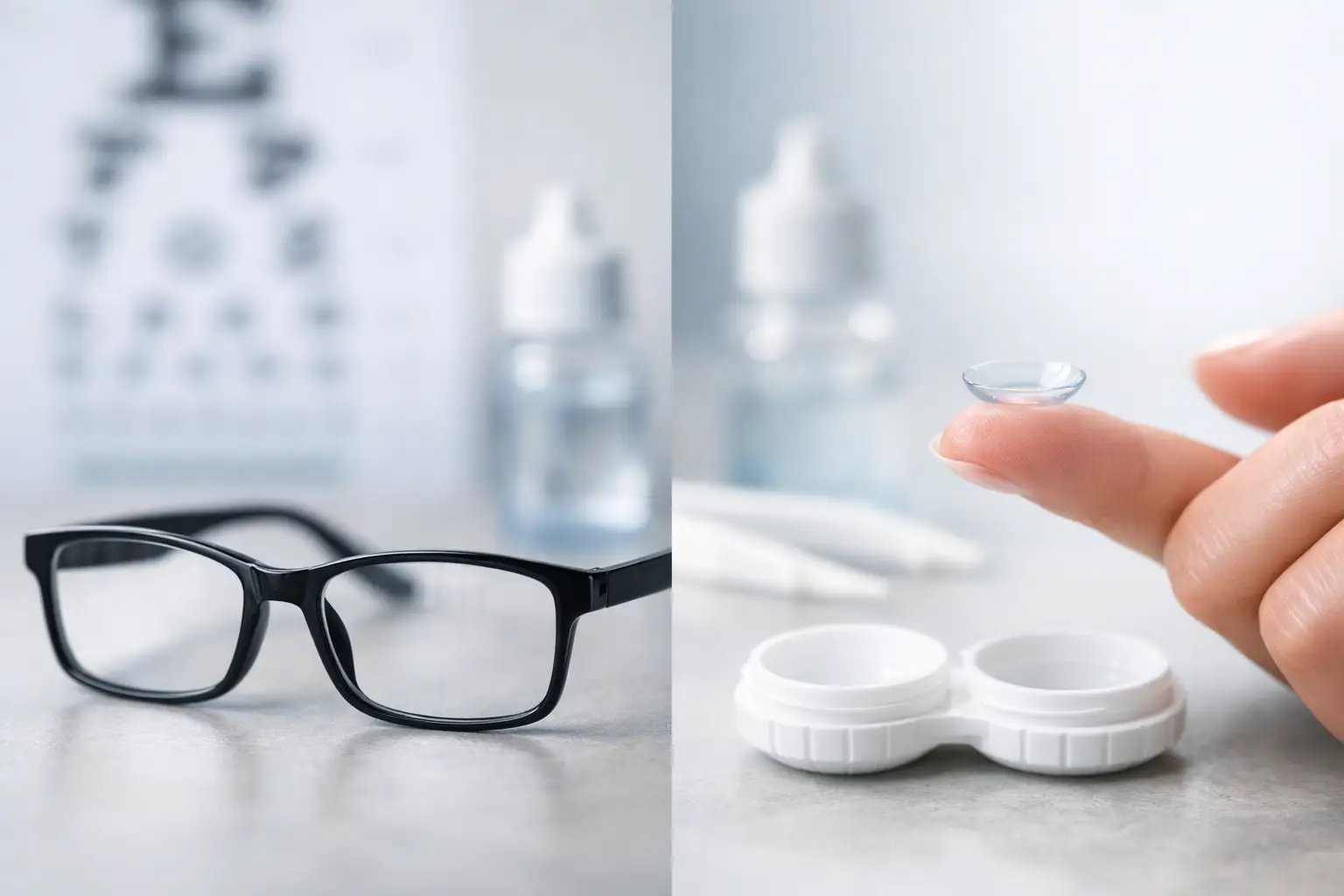
Choosing between glasses or contact lenses usually becomes real at the most inconvenient moment – when you are squinting at your phone, struggling with night driving, or tired of pushing frames back up your nose for the fifth time that day. For some people the answer is obvious. For many others, it is less about which is better and more about which fits their lifestyle, comfort and budget.
That is why this decision deserves a bit more than a quick guess. The right choice depends on how you work, how active you are, how sensitive your eyes feel by the end of the day and how much maintenance you are realistically willing to keep up with. A good eye care appointment should help you weigh those factors properly, not rush you into one option.
Glasses or contact lenses: the real difference
Glasses sit in front of the eye and correct your vision without touching the surface of it. Contact lenses do the same job from directly on the eye, which changes how they feel, how they perform and how they need to be looked after.
Glasses are often the simpler option. You put them on, take them off, clean the lenses and keep them in a case when they are not in use. There is no need to place anything in your eye, and there is generally less day-to-day upkeep. For children, busy parents and anyone who wants the lowest-fuss option, that matters.
Contact lenses can offer more freedom in certain situations. They do not steam up in winter, slide down your face or get splashed with rain. They can be especially useful for sport, social occasions and people who prefer not to wear frames at all. The trade-off is responsibility. Lenses need proper hygiene, careful handling and regular replacement.
When glasses tend to work best
For many patients, glasses remain the most practical starting point. They are easy to manage, easy to update and usually straightforward to wear from day one. If your eyes are prone to dryness or irritation, glasses can also feel more comfortable over long hours.
They also suit people who spend a lot of time at screens and want to remove their correction quickly to rest their eyes. If you are juggling school runs, commuting and work, the simplicity can be a genuine advantage.
There is also the style factor. Some people love their glasses and see them as part of how they present themselves. Modern frames give plenty of choice, whether you want something subtle, smart or a bit bolder. In that case, glasses are not just a vision aid. They become part of your everyday look.
Cost can play a part too. While prices vary depending on lenses and coatings, glasses often feel easier to budget for because you buy them less frequently than contact lenses. That predictability suits households trying to keep healthcare spending clear and manageable.
When contact lenses make more sense
Contact lenses can be a very good fit for people who value freedom of movement and a more natural field of vision. Because the lenses move with your eyes, there is no frame edge in your line of sight. Many people notice this most when driving, exercising or moving quickly between tasks.
They can also be helpful if you dislike the physical feel of wearing glasses. Some patients simply never get used to frames on the bridge of the nose or behind the ears. Others prefer how they look without them, especially for work meetings, events or photographs.
If you play sport regularly, contact lenses may be the more convenient option. They do not bounce, slip or mist up. For activities where glasses can feel restrictive, lenses often provide a more stable experience.
That said, comfort depends on the individual. Some people take to lenses immediately. Others need a little time to adapt, and a few decide they would rather not deal with inserting and removing them at all. There is nothing unusual about that.
Glasses or contact lenses for comfort
Comfort is where the choice often becomes personal. Glasses can pinch, feel heavy or leave marks if they do not fit properly, but when fitted well they are usually easy to forget about. Contact lenses can feel wonderfully unobtrusive once settled, but only if your eyes tolerate them well.
Dry eye is one of the biggest deciding factors. If your eyes already feel gritty or tired, especially in heated rooms or after long screen use, contact lenses may become uncomfortable before the end of the day. That does not automatically rule them out, but it does mean the type of lens and your wearing routine need proper thought.
Allergies can also affect the decision. During hay fever season, some patients find lenses less comfortable because pollen and irritation make the eyes more sensitive. In those cases, having glasses as a backup is useful even if you prefer contacts most of the time.
Practical upkeep matters more than people expect
The best vision correction is the one you will actually use properly. Glasses need cleaning and occasional adjustment, but that is about it. Contact lenses ask more of you. Your hands must be clean, your lens case must be hygienic if you use reusable lenses, and replacement schedules need to be followed exactly.
This is not a minor detail. Wearing lenses for too long or caring for them poorly can increase the risk of irritation and infection. Most problems are avoidable with good habits, but it does mean contact lenses are not simply a cosmetic swap for glasses. They are a medical device and should be treated that way.
For teenagers and adults alike, honesty helps here. If you know you are likely to be lax with routines, glasses may be the safer and more sensible main option. If you are organised and happy with the care involved, contact lenses can work very well.
Can you wear both?
Yes, and many people do. In fact, this is often the most flexible answer. You might wear contact lenses for work, exercise or evenings out, then switch to glasses at home or on days when your eyes feel tired.
This approach gives you choice without forcing everything onto one solution. It also means you always have a backup. If your eyes are irritated, if you have a cold, or if you simply cannot be bothered with lenses that day, your glasses are there.
For plenty of patients, this balance turns out to be the most realistic. It combines convenience with comfort and avoids the feeling that you have to commit fully to one camp.
What about children and teenagers?
Children usually begin with glasses because they are simpler to supervise and easier to manage. For school, reading and day-to-day wear, they are often the most straightforward choice. The key is making sure the fit is correct and the child is comfortable wearing them consistently.
Teenagers may become interested in contact lenses for confidence, sport or social reasons. That can be perfectly reasonable, provided they are ready for the hygiene and responsibility involved. Maturity matters more than age alone.
Parents often worry that asking about contact lenses means a child is rejecting glasses altogether. Usually it is more practical than that. They may just want an option for football, dance, or special occasions. A proper discussion can help decide what is suitable.
How to decide without overthinking it
A useful way to decide is to think about your ordinary week, not your ideal one. If most days involve commuting, screens, errands and a quick evening at home, what will feel easiest to keep up with? If your week includes regular gym sessions, outdoor work or events where glasses get in the way, contact lenses may earn their place.
It also helps to think beyond appearance. Vision quality, comfort at the end of the day, eye health and running costs all matter. There is rarely a perfect universal answer, only the answer that makes the most sense for you.
That is where a thorough eye examination and conversation make the difference. A good optometrist will look at your prescription, check the health of your eyes, ask about your routine and explain the pros and drawbacks clearly. At Eyespy Eye and Dental Care, that kind of personal advice is a big part of helping patients feel confident in their choice rather than pressured into one.
If you are still undecided, that is completely normal. Choosing between glasses or contact lenses is not a test with one right answer. It is a practical decision about what helps you see comfortably and live more easily – and sometimes the best choice is giving yourself both options.