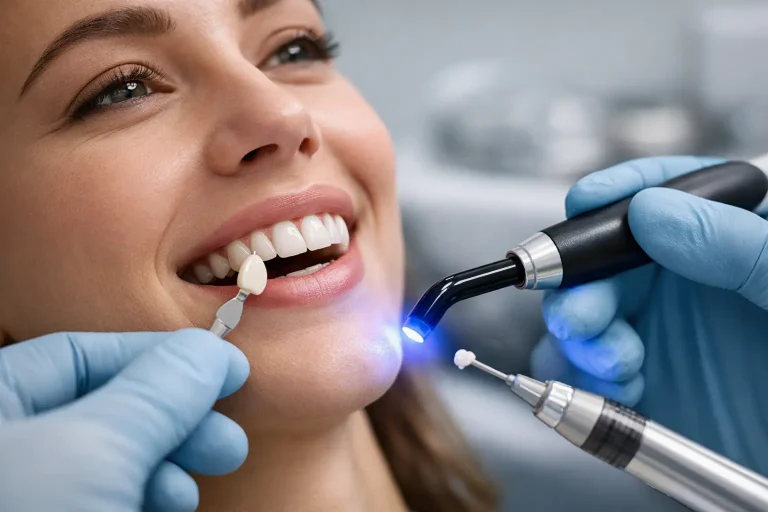
Losing a tooth rarely feels like a small thing. It can change how you chew, how you speak, and how confident you feel when you smile or laugh. This guide to dental implant treatment is designed to answer the questions patients often ask in clinic – what implants are, who they suit, how treatment works, and what the process really feels like from start to finish.
Dental implants are a long-term way to replace missing teeth. Rather than relying on neighbouring teeth for support, an implant is placed into the jawbone to act as an artificial tooth root. Once it has healed, it can support a crown, bridge or denture depending on how many teeth need replacing. For many patients, the biggest appeal is stability. Implants are fixed in place, so they tend to feel more secure and natural than removable options.
What dental implant treatment actually involves
When people hear the word implant, they often imagine a single appointment. In reality, dental implant treatment is usually a staged process. That is not a bad thing. It simply means each part of the treatment is planned carefully, with time allowed for healing and checks along the way.
A standard implant has three main parts. The implant itself is the small titanium post placed in the jaw. The abutment is the connector that sits on top. The crown is the visible part that looks like a tooth. In some cases, treatment may involve more than one implant, or a different final restoration if several teeth are missing.
The detail matters because no two mouths are the same. The position of the missing tooth, the strength of the surrounding bone, the health of the gums, and your bite all affect the plan. Good implant treatment is never rushed.
Who is suitable for implants?
Many adults are suitable for implants, but suitability depends on oral health and bone support rather than age alone. If your gums are healthy and there is enough bone to hold the implant securely, treatment may be straightforward. If there has been tooth loss for a long time, the bone may have reduced in volume, which can make things more complex.
Smoking, uncontrolled diabetes, active gum disease and heavy teeth grinding can all affect healing and long-term success. That does not always mean implants are off the table, but it may mean another issue needs addressing first. This is one reason a proper assessment matters. A careful dentist will explain not just whether implants are possible, but whether they are likely to be predictable in your case.
For some patients, implants are ideal for replacing one tooth. For others, they help stabilise a denture or support multiple replacement teeth. The right answer depends on what you need functionally, aesthetically and financially.
Your guide to dental implant treatment starts with assessment
The first stage is always assessment and planning. This appointment is where your dentist looks at the health of your teeth and gums, checks the gap, discusses your goals, and reviews your medical history. X-rays and sometimes a 3D scan may be needed to assess bone levels and identify important structures such as nerves or the sinus.
This planning stage is where expectations are set properly. You should be told whether the treatment is simple or complex, how long it is likely to take, whether any additional procedures may be needed, and what the costs are likely to be. Transparent conversations at the beginning usually make the whole process feel much less daunting.
If you are already wearing a denture or have had a missing tooth for years, this stage is especially important. Longstanding gaps can affect bone shape and the way the bite has settled over time. Sometimes minor preparatory treatment is needed before an implant can be placed safely.
The implant placement procedure
The idea of implant surgery sounds more intimidating than it usually feels. In most cases, the implant is placed under local anaesthetic, much like other routine dental procedures. Once the area is numb, the implant is positioned carefully into the jawbone. Patients often say the anticipation was worse than the appointment itself.
After placement, the gum may be stitched and the site is left to heal. Mild swelling, tenderness and bruising can happen for a few days, but this is usually manageable with the advice and medication recommended by your dentist. Most people are back to normal daily activity quite quickly, although it is sensible to avoid strenuous exercise immediately after the procedure.
Healing time varies. In many cases, the implant is then left for a few months so the bone can bond with its surface. This process is called osseointegration. It is the reason implants can be so stable in the long term, but it also means patience is part of the treatment.
Do you always get a tooth on the same day?
Sometimes yes, sometimes no. This depends on the position of the implant, the quality of the bone, and how much pressure the area will be under during healing. In some cases, a temporary tooth can be fitted quickly for appearance. In others, it is better to allow the implant to heal undisturbed before attaching anything permanent.
This is one of those areas where honest advice matters. Same-day solutions can sound appealing, but they are not automatically the best option for every patient. A more cautious approach can give a stronger long-term result.
What if you do not have enough bone?
A lack of bone does not always rule out implant treatment, but it may mean extra procedures are needed. Bone grafting is sometimes used to build up the area so the implant has better support. In the upper jaw, a sinus lift may occasionally be discussed if there is limited bone height at the back.
These added steps can increase treatment time and cost, so it is worth knowing this early. For some patients, alternatives to implants may still be the more practical route. A good clinician should talk through the pros, cons and compromises clearly rather than making implants sound like the only answer.
Fitting the final crown
Once the implant has healed well, the final stage is restoring it with the visible tooth. Impressions or digital scans are taken so the crown can be made to match your smile as closely as possible. Attention to shape, shade and bite is important here. The implant needs to look good, but it also needs to work comfortably when you eat and speak.
When the final crown is fitted, the result should feel secure and natural. There can be a short adjustment period while your mouth gets used to the new tooth, particularly if the gap has been there for some time. Most patients adapt quickly.
How long do dental implants last?
Implants can last many years, but they are not maintenance-free. Their lifespan depends on planning, placement, bite forces, gum health and home care. The implant itself cannot decay, but the surrounding tissues can still become inflamed. If plaque builds up and the gums are neglected, problems can develop around the implant just as they can around natural teeth.
That is why aftercare matters so much. Regular reviews, good brushing, cleaning carefully around the implant, and professional hygiene visits all help protect the investment you have made. If you grind your teeth at night, a protective appliance may also be recommended.
Understanding the cost of treatment
One of the first questions patients ask is whether implants are expensive. Compared with fillings or standard crowns, yes, they are a bigger financial commitment. But cost should be looked at in context. Implant treatment involves detailed planning, clinical time, high-quality components and follow-up care.
The final figure can vary depending on how many teeth are being replaced and whether grafting or other preparatory treatment is needed. This is why personalised treatment plans are more useful than rough online estimates. What matters most is that fees are explained clearly from the start, with no vague promises and no pressure.
For some patients, spreading the cost makes treatment more manageable. If finance is available, it can help turn a long-considered treatment into something realistic without compromising on quality.
Questions worth asking before you go ahead
Before starting treatment, it is sensible to ask how many stages your case is likely to involve, how long healing may take, what sort of restoration is planned, and how the implant will be maintained afterwards. It is also reasonable to ask about risks. While dental implants have high success rates, no treatment is risk-free. Infection, failure to integrate, gum recession, or technical wear over time are all possibilities, even when care is good.
A trustworthy practice will not brush those questions aside. Clear explanations are part of good care. At Eyespy Eye and Dental Care, that patient-centred approach matters because treatment decisions tend to feel easier when you understand both the benefits and the limits.
If you are considering implants, the most useful first step is not guessing from adverts or trying to compare your mouth to someone else’s. It is having a proper conversation with a dentist who will assess your situation, explain it plainly, and help you choose the option that feels right for your health, your confidence and your day-to-day life.